When we think of honey, its sweet flavor is usually the first characteristic that comes to mind. And it is no coincidence: sugars represent the majority of its composition, primarily fructose and glucose.
However, saying that honey is just sugar oversimplifies a food whose composition is the result of the interaction between bees, plants, and the environment. In addition to carbohydrates, honey contains water and small amounts of organic acids, enzymes, amino acids, proteins, minerals, and phenolic compounds.
The proportions of these components are not exactly the same in all honeys. Floral origin, environmental conditions, processing, and storage help explain why one honey can differ from another in color, aroma, flavor, texture, and even in its behavior over time.
What Is Honey Made Of?
Honey is produced by bees from the nectar of flowers or other plant secretions. During this process, the collected raw material undergoes transformations involving enzymatic activity and a reduction in water content.
In the final product, carbohydrates represent the largest portion of the composition. Among them, two simple sugars stand out: fructose and glucose.
In much smaller quantities, honey may also contain:
- organic acids;
- enzymes;
- amino acids and small amounts of proteins;
- minerals;
- phenolic compounds, including flavonoids and phenolic acids;
- other natural components related to its origin.
Although present in small proportions compared to sugars, these elements are part of the food’s chemical and sensory complexity.
Fructose, Glucose, and Sucrose: What Is the Difference?
Not all sugar is chemically the same. Fructose and glucose, predominant in honey, are classified as monosaccharides—that is, sugars with a simpler structure.
Sucrose, in turn, is formed by the union of a glucose molecule with a fructose molecule. It is precisely sucrose that constitutes traditional table sugar.
Therefore, although both honey and table sugar provide sugars to the diet, their compositions are not identical. In honey, fructose and glucose already appear predominantly in their simple form, accompanied by water and other natural components present in small quantities.
This difference does not turn honey into a food that can be consumed without moderation. It remains a significant source of sugars and should be part of a balanced diet.
Why Does the Proportion Between Sugars Matter?
The relationship between fructose, glucose, and water helps determine some of honey’s physical characteristics. One of these is its tendency to remain liquid or form crystals over time.
Glucose has lower solubility in water than fructose. Depending on the honey’s composition and storage conditions, it may begin to separate from the solution and form crystals.
This helps explain why some honeys crystallize more quickly while others remain fluid for longer periods. The change does not automatically mean the product has spoiled.
As this subject involves several other factors, we have already explained the process in detail in the article Has Crystallized Honey Spoiled? Understand Why This Happens and What to Do.
What Are the Phenolic Compounds Present in Honey?
Among the components found in small quantities in honey are phenolic compounds, substances of plant origin that include groups such as flavonoids and phenolic acids.
These compounds are studied, among other reasons, for their relationship with the antioxidant activity observed in different types of honey. Their presence and concentration, however, are not fixed: they can vary according to the botanical and geographical origin of the product, in addition to other factors.
It is important to put this information into perspective. The presence of these components does not eliminate the fact that honey is predominantly composed of sugars and does not mean its consumption should be unlimited.
The interest lies precisely in understanding that, from a compositional standpoint, there is more inside a jar of honey than just molecules responsible for the sweet taste.
Can the Bloom Change the Composition of Honey?
Yes. The plants visited by bees provide nectars with different characteristics. Therefore, botanical origin is one of the factors that help determine the identity of each honey.
In addition to the predominant bloom, the production region, climate, environmental conditions, and harvest period also enter this equation. As a result, different honeys can present distinct shades, aromas, flavors, and textures.
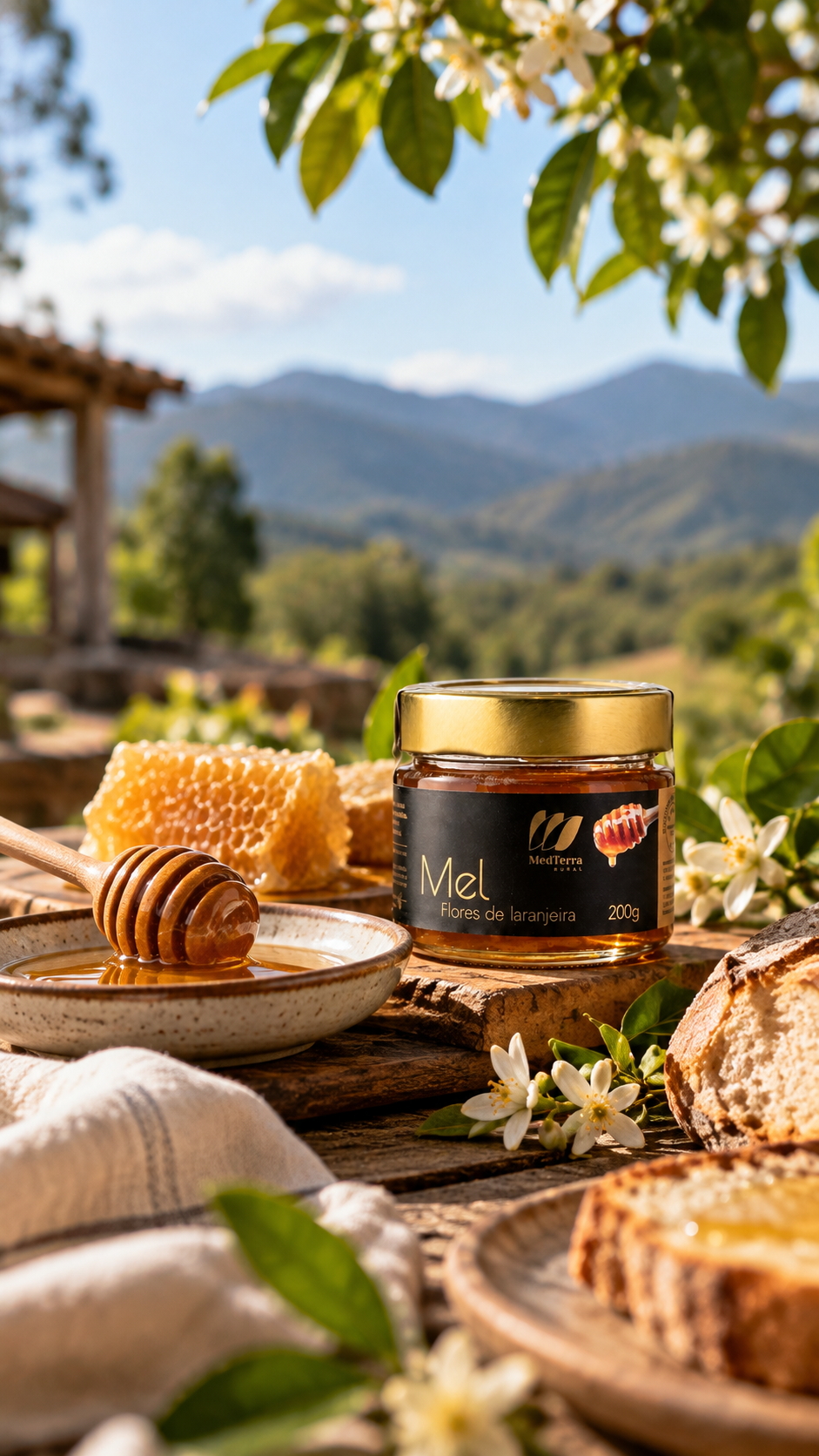
Orange blossom honey, for example, may present sensory characteristics different from those found in honeys from other blooms. These variations are part of the food’s relationship with its origin.
For this reason, color alone should not be used to determine the quality of a honey. There are products that are naturally lighter or darker depending on their composition and provenance. In the MedTerra Diary, we have gathered other important criteria in the article How to Choose Quality Honey: 7 Signs You Should Look For.
Can Processing Also Make a Difference?
In addition to origin, the way honey is processed after harvest can interfere with some of its characteristics.
Heating, for example, may be used during processing to facilitate bottling, reduce viscosity, or delay crystal formation. Temperature and heat exposure time, however, need to be controlled because excessive heating can modify sensory characteristics and some of the product’s components.
This is one of the important differences between products that undergo or do not undergo certain thermal treatments. To better understand this process, see also Raw Honey and Pasteurized Honey: What Is the Difference?.
So, Are Honey and Table Sugar the Same Thing?
No. Although both are sources of sugars and should be consumed in balance, their composition is different.
Table sugar consists essentially of sucrose. Honey, in turn, contains mainly fructose and glucose, water, and small amounts of other natural components.
This also means that it is not necessary to resort to the opposite extreme and treat honey as a nutritionally unlimited substitute for sugar. The most correct approach is to recognize the differences between the foods without ignoring what they have in common: both provide sugars to the diet.
A Food That Carries the Characteristics of Its Origin
Understanding the composition of honey helps one realize why products from different origins can present such distinct characteristics.
From the flower visited by the bees to the environmental conditions of the region, through harvesting, processing, and storage, different stages leave their mark on the final product.
Therefore, knowing the provenance is more informative than evaluating honey solely by color, fluidity, or home tests. Identified origin, proper labeling, and clear information about production help the consumer better understand the food they are taking home.
Honey is, indeed, a food predominantly composed of natural sugars. But reducing its entire composition to that leaves out precisely the elements that help explain its diversity of aromas, flavors, colors, and textures.
Behind the sweet taste, there is a food whose composition also tells a story about flowers, bees, territory, and production.