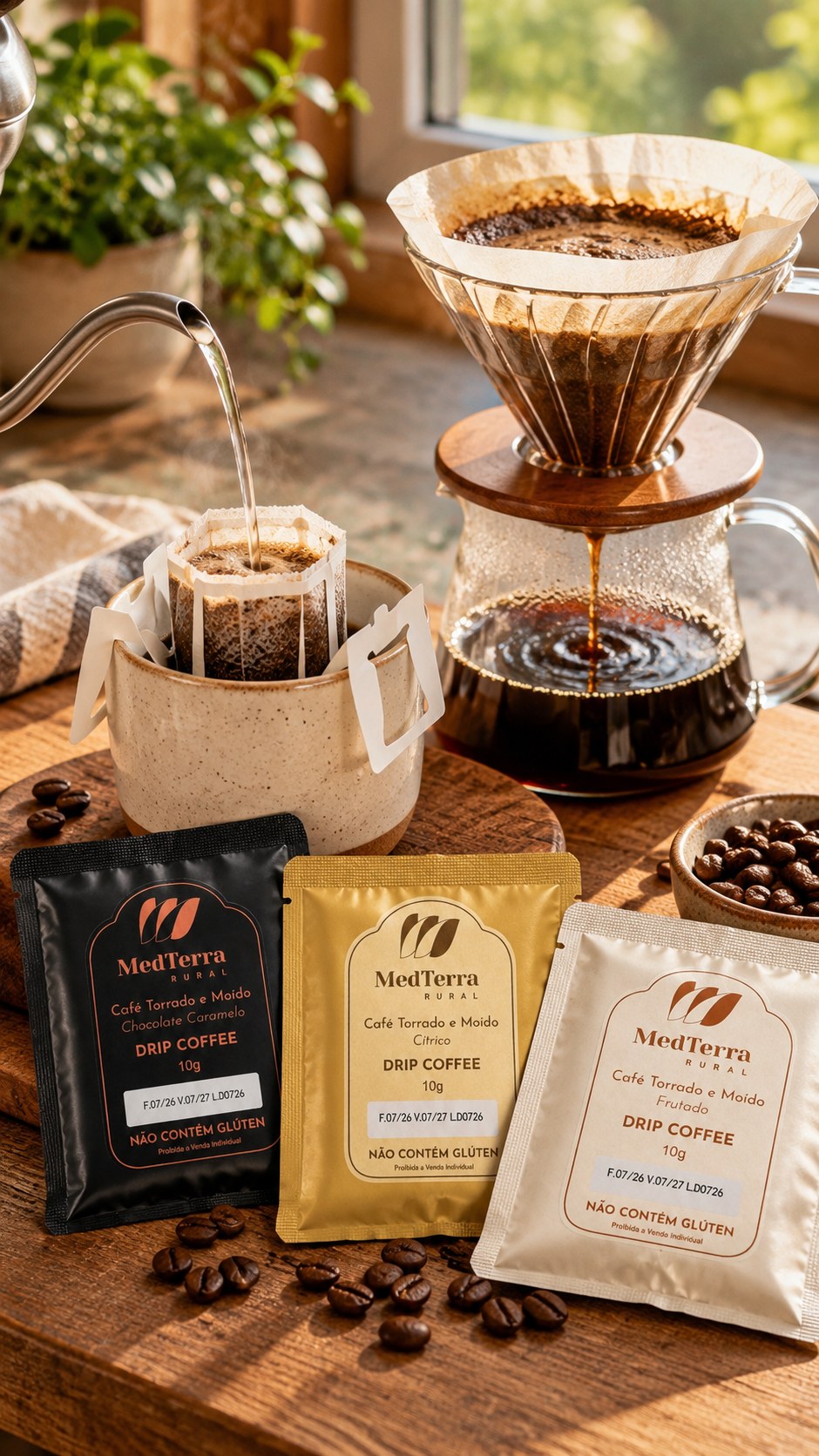
Preparing a good coffee can be a ritual full of details or a simple, practical experience. Among filtered methods, two options represent these possibilities very well: the V60, which allows for control over different variables during brewing, and Drip Coffee, which brings the logic of filtered coffee into an individual, portable format.
Although both use ground coffee, a filter, and hot water, the experience is not exactly the same. The shape of the filter, the amount of coffee, the water flow, and, primarily, the level of control during extraction can influence the result in the cup.
Understanding these differences helps not only in choosing a method but also in noticing how small changes in preparation can reveal distinct characteristics of the same coffee.
What is the V60?
The V60 is a filtered coffee method known for the conical shape of its filter holder and the wide opening at its base. Its name refers to the 60-degree angle of its walls.
During preparation, the ground coffee is placed in a paper filter and hot water is poured manually. It is precisely at this moment that some of the method’s main possibilities arise: the brewer can control the speed of the pour, the amount of water used in each stage, and the total extraction time.
Other factors also influence the result, such as the grind size, water temperature, and the ratio between coffee and water.
For this reason, the V60 usually appeals especially to those who enjoy exploring different ways to prepare coffee and observing how each adjustment modifies the drink.
And what is Drip Coffee?
The Drip Coffee uses the same basic principle of filtration: hot water passes through the ground coffee and the filter before reaching the cup. The big difference lies in its practicality.
The coffee comes pre-portioned in an individual filter, usually packaged in a way that helps preserve its characteristics until the moment of consumption. Upon opening the sachet, simply place the filter flaps over the edges of the cup and gradually add hot water.
There is no need for a filter holder, scale, or other specific equipment. Therefore, the format works well in situations where one wishes to prepare a single cup with few utensils: at the office, while traveling, in hotels, or even at home.
This practicality, however, does not turn Drip Coffee into instant coffee. In soluble coffee, the product is dissolved in water. In Drip Coffee, filtration extraction occurs: water passes through the roasted and ground coffee, carrying the soluble compounds responsible for aromas and flavors into the drink.
Do Drip Coffee and V60 use the same type of extraction?
Both belong to the family of filtered methods and work with percolation: water passes through the coffee and moves toward the cup with the help of gravity.
What changes is primarily the degree of control.
In the V60, it is possible to change the grind, the dose, the coffee-to-water ratio, and the way the water is poured with greater freedom. A change in the speed or pattern of the pour, for example, can alter the water’s contact with the coffee particles and, consequently, the extraction.
In Drip Coffee, some of these variables are predefined, especially the amount of coffee and the filter shape. This reduces steps and makes the preparation more predictable and accessible.
Is the result in the cup different?
It can be. But there is no rule stating that one method necessarily produces a “better” drink than the other.
In the V60, greater control allows for adjustments to highlight certain sensory characteristics of the coffee. Depending on the bean and the recipe, it is possible to seek a more delicate or intense drink, or one with different perceptions of acidity and sweetness.
In Drip Coffee, the goal is to offer consistency and convenience. Since the dose and filter are already set, there are fewer variables to manage on a daily basis.
In both cases, however, the quality of the coffee used remains fundamental. Origin, variety, processing, roast, grind, and preservation directly influence what will be perceived in the cup.
The water also makes a difference
Regardless of the chosen method, water represents the largest part of the finished drink and deserves attention.
In addition to its composition, temperature affects extraction. Excessively cold water can make it difficult to properly extract certain coffee compounds. On the other hand, it is not necessary to maintain an intense boil during preparation.
After heating the water, the pour should be done in a controlled manner, aiming to wet the coffee uniformly. In Drip Coffee, it is worth avoiding filling the filter all at once. Adding water gradually favors a more balanced brew and reduces the risk of overflowing.
So, when to choose each method?
The V60 can be a great choice for those who appreciate the brewing process itself. Grinding the coffee, weighing the ingredients, watching the time, and experimenting with different recipes are all part of the experience.
Drip Coffee, on the other hand, serves especially well for moments when practicality is important, but one still wishes to consume filtered coffee. A mug and hot water are enough to complete the preparation.
This makes the methods less competitive and more complementary. The same person might prepare their coffee in a V60 when they have time for the ritual and turn to Drip Coffee on a busy morning, during a trip, or in the workplace.
Practicality doesn’t have to mean giving up the experience
For a long time, convenience and quality were treated almost as opposing ideas in the coffee world. Today, different formats show that it is possible to simplify steps without necessarily abandoning attention to the raw material and preparation.
Drip Coffee is an example of this change: it transports the principle of filtered coffee into an individual and portable solution. The V60, on the other hand, preserves a more manual experience, in which each variable can be explored.
In the end, the choice depends less on discovering which method is superior and more on understanding which experience makes sense for each moment.
Because preparing coffee is also about that: adapting the ritual to the available time without failing to pay attention to what reaches the cup.