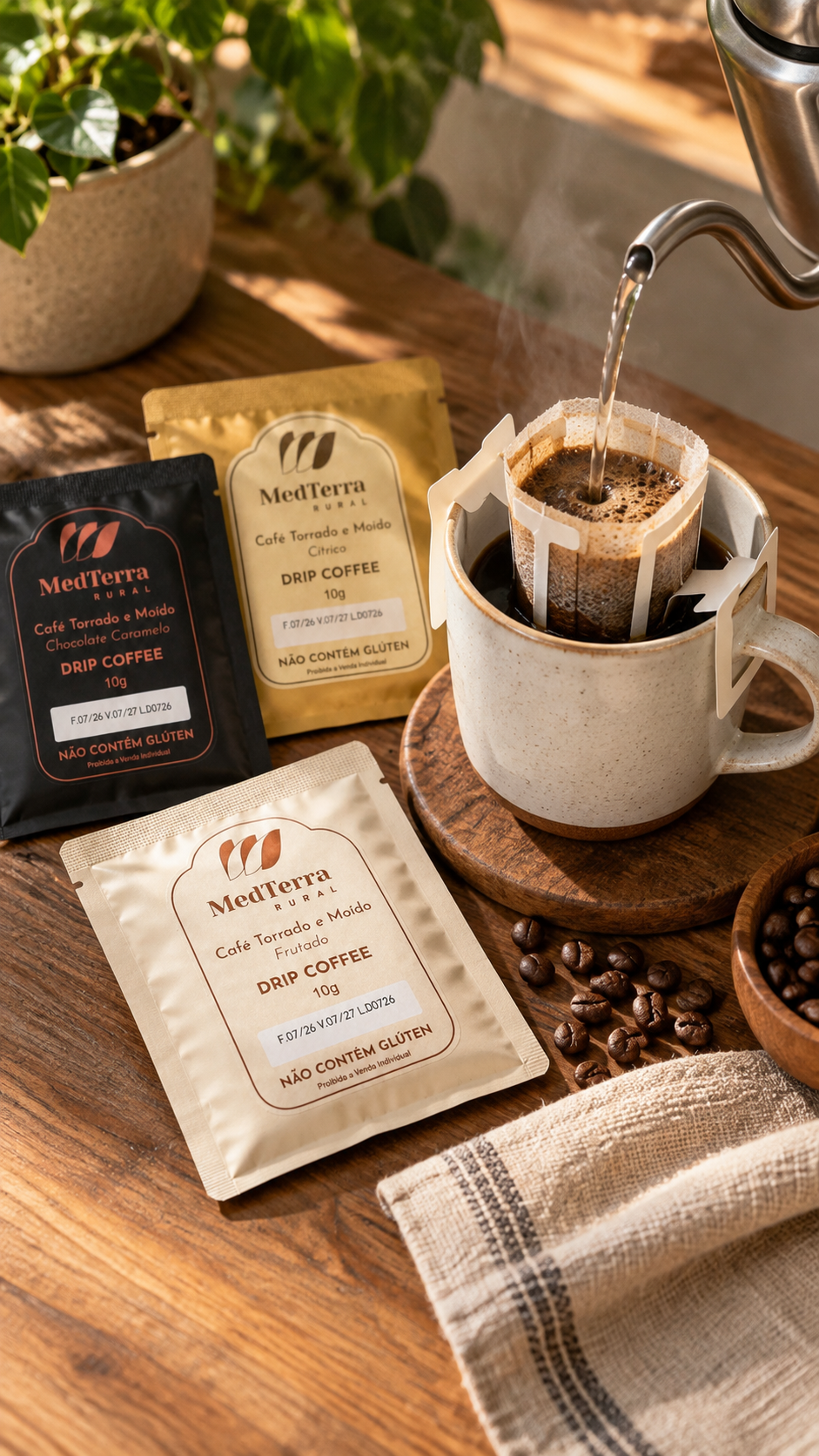
Drip Coffee has gained popularity among those who enjoy quality coffee but seek a practical way to prepare the beverage. The individual sachet functions as a small filter placed directly over the cup, allowing you to prepare filtered coffee virtually anywhere.
However, a common question arises: Does Drip Coffee have the same amount of caffeine as traditional filtered coffee?
The answer does not depend solely on the format. Since both methods use ground coffee and hot water passing through a filter, they share more similarities than differences. The amount of caffeine in the cup, however, can vary according to several factors.
Where does the caffeine in your cup come from?
Caffeine is a compound naturally present in coffee beans. During preparation, part of it is extracted by water and transfers into the beverage.
Therefore, the final amount of caffeine is not simply determined by whether the coffee is prepared using a Drip Coffee sachet or a conventional filter.
Factors that can influence the amount of caffeine present in the beverage include:
- the quantity of coffee used;
- the species and variety of beans;
- the grind size;
- the coffee-to-water ratio;
- the water temperature;
- the contact time between water and coffee;
- and the final volume of the beverage.
This means that even two cups prepared using the same method can show differences.
Are Drip Coffee and filtered coffee similar methods?
Yes. In traditional filtered coffee, we place ground coffee in a filter and pour hot water over it. With Drip Coffee, the principle is essentially the same.
The main difference lies in the format: the coffee portion comes pre-portioned inside its own filter, which is opened and fitted directly over the cup. Water is then added gradually.
Therefore, Drip Coffee is not instant or soluble coffee. It is roasted and ground coffee prepared by filtration.
If you are not yet familiar with this format, you might also want to read MedTerra Drip Coffee: Specialty Coffee Wherever You Are, where we explain how the individual filter works and introduce the different profiles in the line.
So, does Drip Coffee have more or less caffeine?
There is no single answer.
If we use similar amounts of coffee, similar volumes of water, and comparable extraction conditions, the caffeine content of a Drip Coffee can be in the same order of magnitude as a serving of filtered coffee.
However, small changes in preparation can alter the result.
A beverage prepared with more coffee relative to the amount of water, for example, may be more concentrated. Adding more water to the same sachet increases the beverage volume, but this does not mean that the caffeine will increase proportionally.
Therefore, simply comparing “Drip Coffee versus filtered coffee” is an oversimplification. To understand what is in the cup, we also need to consider how much coffee was used and how the beverage was prepared.
Does stronger coffee mean more caffeine?
Not necessarily. This is one of the most confusing points when we talk about coffee.
The perception of coffee as “strong” involves characteristics such as bitterness, body, roast intensity, and beverage concentration. It does not function as a direct measure of caffeine content.
A coffee that tastes very intense, therefore, does not necessarily contain more caffeine than one with a more delicate sensory profile.
Similarly, characteristics such as citrus, fruity, chocolatey, or caramel notes pertain to the coffee’s sensory profile and do not, by themselves, indicate the amount of caffeine present in that cup.
To better understand where these perceptions come from, also see Why do some coffees have notes of chocolate, fruit, or flowers?.
What about the roast? Does it determine the amount of caffeine?
Roasting causes numerous physical and chemical transformations in the bean and greatly influences the aromas, flavors, body, and other characteristics perceived in the beverage.
However, simply associating “dark roast” with “more caffeine” can also lead to a mistaken conclusion.
The amount of caffeine that reaches the cup depends on a set of factors, including the raw material, the quantity of coffee used, and the extraction conditions.
It is more accurate, therefore, to look at the preparation as a whole rather than trying to predict caffeine content solely by the color or sensory intensity of the beverage.
What is the advantage of Drip Coffee?
The main advantage lies in its practicality combined with the filtration method.
Since the coffee quantity is already portioned and the filter comes with the product, there’s no need to carry a filter holder, coffee maker, or measure the grounds. All you need is a cup and hot water.
This facilitates consuming filtered coffee in the office, while traveling, in hotels, at meetings, or in situations where preparing a single cup by the conventional method would be less practical.
MedTerra Drip Coffee features 100% Arabica specialty coffees from Mantiqueira de Minas in three sensory profiles: Chocolate Caramel, Fruity, and Citrus.
Preparation still makes a difference
Even with the pre-portioned serving, the way water is poured affects the beverage’s outcome.
Adding water gradually helps promote a more balanced extraction. Temperature, water volume, and contact time also influence what we perceive in the cup.
Therefore, those who use this format can better enjoy each profile by following a few simple steps. In the MedTerra Journal, we have compiled these guidelines in the article How to properly prepare Drip Coffee to extract the best aroma and flavor.
In summary
- Drip Coffee and filtered coffee use the filtration principle.
- Drip Coffee is not instant coffee: inside the filter, there is roasted and ground coffee.
- The format alone does not determine the beverage’s caffeine content.
- Coffee dose, water volume, and extraction conditions affect the result.
- A coffee perceived as “stronger” does not necessarily have more caffeine.
- The main advantage of Drip Coffee lies in its practicality and standardized portion.
MedTerra Explains
Does Drip Coffee have the same amount of caffeine as filtered coffee? It can have similar values when coffee quantity, water volume, and preparation conditions are comparable. However, there isn’t a single amount determined solely by the method. The caffeine present in the cup results from the combination of the coffee itself and how it was prepared.
Conclusion
The best way to understand Drip Coffee is to think of it as an individual, portable version of filtered coffee preparation.
By definition, it does not inherently have more or less caffeine simply because it comes in a sachet. The result depends on the coffee used, the amount of water, and the extraction conditions.
For those seeking convenience, this format allows you to bring the filtered coffee experience to situations where setting up the traditional preparation would not be feasible.
And caffeine? It naturally remains part of the beverage. But, as with any coffee, what ends up in your cup depends on much more than just the chosen method.