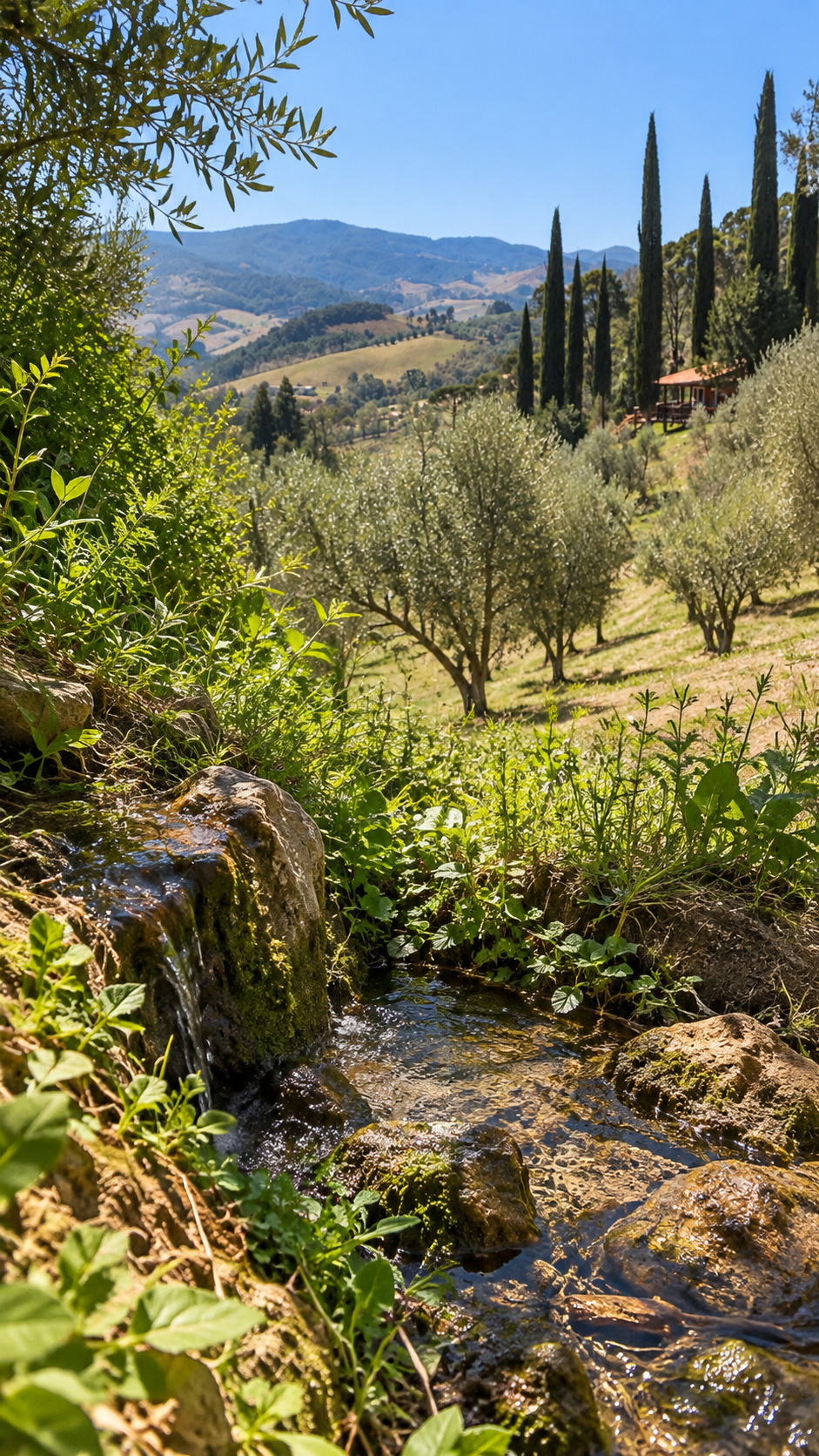
Before the food, comes the water
When we think about the origin of a coffee, an olive oil, a fruit, or any other food produced in the countryside, it is natural to imagine the soil, the climate, the cultivated variety, and the work of the producer. But there is an element that participates in practically all of these stages and often remains invisible: water.
It is present in the formation of plants, in the life of the soil, in the balance of ecosystems, and at different moments of rural activity. Therefore, caring for springs, watercourses, and the areas that help protect them is not something separate from food production. It is part of it.
A spring does not begin exactly where the water appears
The water we see bubbling up in a spring is the result of a much larger process. Rain falls, meets the soil, and when the right conditions exist, part of it manages to slowly infiltrate the ground, replenishing underground reserves that can feed springs and watercourses.
This is why the conservation of vegetation and soil around these areas is so important. Roots help structure the ground, organic matter promotes infiltration, and plant cover reduces the direct impact of rain on the soil.
When the soil is excessively exposed or compacted, the opposite occurs: surface runoff increases, as does the risk of erosion. Consequently, soil particles can be carried into streams and rivers, contributing to siltation.
Water and soil are part of the same system
On the farm, it is difficult to talk about water conservation without talking about soil health.
Well-tended soil is not just the place where a plant fixes its roots. It houses organisms, stores nutrients, retains part of the rainwater, and creates conditions for crops to pass through periods of lower water availability with greater balance.
Practices that reduce erosion, preserve soil cover, and respect the natural characteristics of the land help build a more resilient productive environment.
At MedTerra, this relationship between production and preservation is part of the farm landscape itself. At Fazenda São Bento, in the Mantiqueira Mountains, olive trees and coffee plantations coexist with preserved springs and native flora. It is a concrete way to see how agricultural production and care for natural resources can be part of the same system. Learn more about the origin of MedTerra Rural.
Preserving the spring is also thinking about the food of tomorrow
Producing food depends on natural cycles that cannot be viewed only in the short term. A rural area needs to remain productive after the next harvest—and, ideally, for many generations.
Protecting springs and areas near watercourses, avoiding erosion processes, conserving vegetation, and properly managing the soil are actions that help keep this cycle functioning.
And there is an important point in this conversation: preservation and production do not need to occupy opposite sides. In a well-managed rural property, they are part of the same planning.
The water available tomorrow depends, to some extent, on the way the landscape is cared for today.
What does this have to do with food quality?
A lot.
The characteristics of a food begin to be built while still in the field. Soil, water availability, temperature, altitude, cultivated variety, harvest time, and agricultural management form a set of factors that influence plant development and, consequently, what will be harvested.
In coffee, for example, origin, cultivation environment, and processing help build the different profiles found in the cup. Soil, altitude, temperature, rainfall, and sunlight are among the factors that can interfere with fruit development and the sensory characteristics of the beans. If you want to better understand this relationship, read also: Why can the same coffee have different flavors? Understand what changes from the farm to the cup.
Something similar occurs with extra virgin olive oil: quality begins long before the olives reach the mill. The care of the olive grove, the harvest point, and the entire process carried out afterward are part of the final result.
Producing is also caring for the origin
When we look at a finished food product, we see a bottle of olive oil, a bag of coffee, a jar of honey. In the field, however, each product is part of a much larger landscape.
There are soil, water, plants, insects, microorganisms, climate, and people working together.
Preserving a spring may not be the most visible stage of food production. It does not appear on the label or in the cup. But it represents something essential: understanding that quality is also built by caring for the resources that make production possible.
Because, before reaching the table, all food has an origin. And caring for that origin is also a way of thinking about the future.