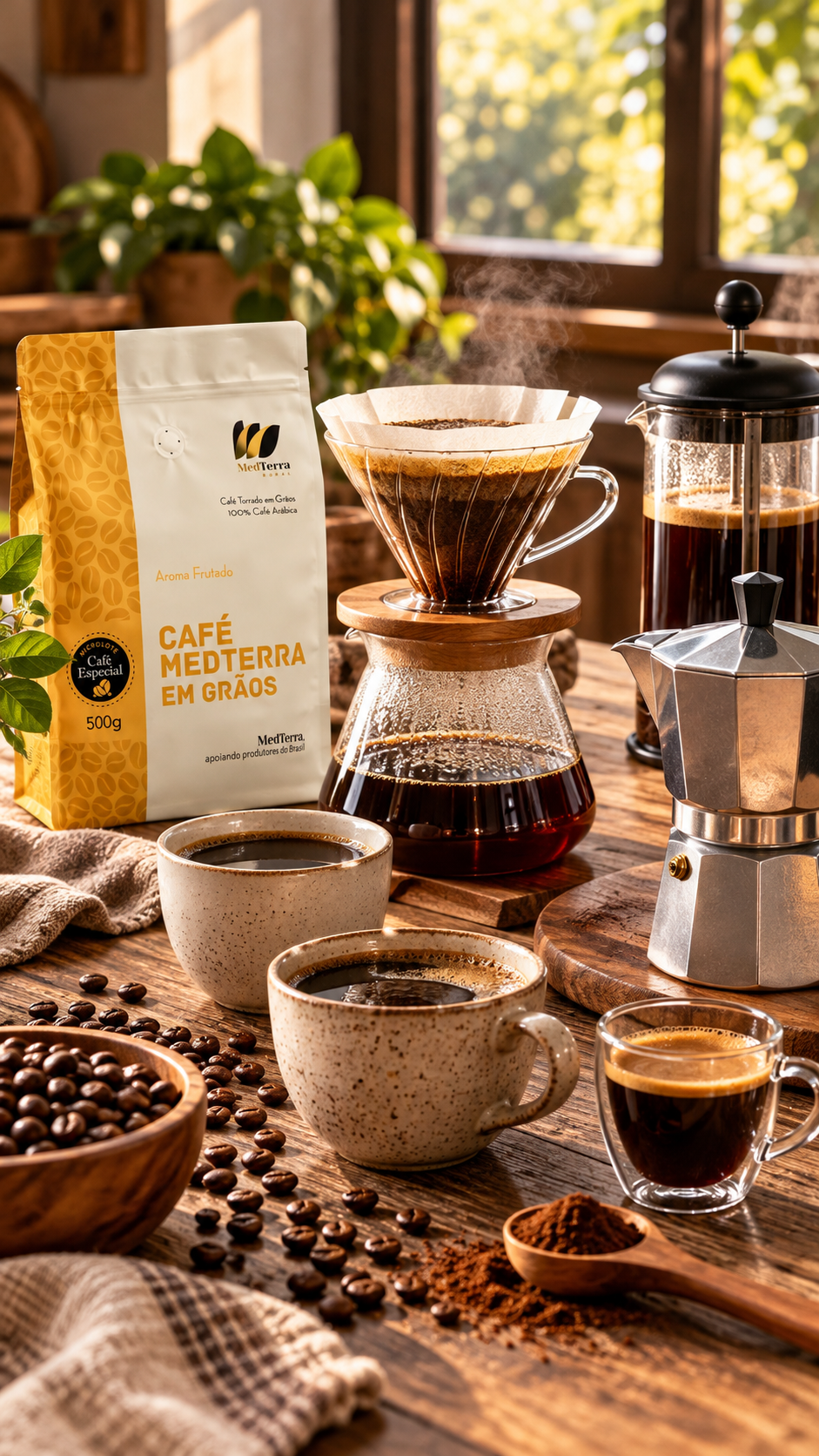
V60, Italian coffee maker, French press, espresso, traditional pour-over. We can start with the same beans and still end up with very different cups.
This happens because preparing coffee is essentially an extraction. When water comes into contact with ground coffee, it extracts hundreds of substances from the bean that can influence aroma, flavor, body, and the final composition of the beverage.
And the chosen method interferes with this process. Contact time, temperature, pressure, grind size, and especially the type of filtration determine what passes from the coffee to the cup — and in what quantity.
💡 In Summary
- The preparation method affects the final composition of the coffee.
- Time, temperature, pressure, and grind size modify the dynamics of extraction.
- Paper filters retain a good portion of the oils and lipid compounds present in coffee.
- Methods without paper filters, such as French press and Turkish coffee, allow a greater passage of these components.
- Espresso is very concentrated, but the small serving size must be considered when comparing the total amount of caffeine.
- There is no universally “better” method: each technique produces a different combination of composition and sensory experience.
Preparing Coffee is Also Chemistry
A roasted coffee bean contains a complex mixture of substances. These include caffeine, chlorogenic acids and other phenolic compounds, minerals, melanoidins, aromatic molecules, and a fraction of lipids.
Some of these components are water-soluble and easily pass into the beverage. Others depend more on extraction conditions or can be retained during filtration.
This is why two methods don’t just differ in taste. They can produce beverages with distinct chemical profiles.
This composition begins to be defined even before preparation. The degree of roast, for example, also causes significant transformations in the compounds present in the bean, as we explained in Light or Dark Roast: What Happens to Coffee Compounds During Roasting?.
V60, Melitta, and Other Paper Filter Methods
In paper-filtered methods, water passes through the ground coffee and into the receptacle, while the filter performs a second function: in addition to holding solid particles, it retains a significant portion of the coffee’s oily fraction.
This helps explain why a V60 or coffee prepared with a paper filter typically results in a visually cleaner beverage with fewer suspended particles.
From a compositional standpoint, there’s a particularly interesting consequence: paper reduces the passage of two diterpenes naturally present in coffee, cafestol and kahweol.
Therefore, when we talk about filtered coffee, the filter isn’t just modifying texture and mouthfeel. It is effectively interfering with which components reach the cup.
What about Chemex?
The principle is similar to other paper-filtered methods. One of its characteristics is the use of a thick filter, favoring a beverage with few suspended particles and oils.
The sensory differences between V60, Chemex, and traditional pour-overs also depend on the equipment’s shape, water flow, filter thickness, grind size, and technique used.
French Press: When Oils Remain in the Beverage
In a French press, something different happens. Coffee and water remain in contact for a few minutes, and at the end, a metal screen separates the liquid from most of the grounds.
Since there is no paper filter, a larger quantity of oils and very small particles can remain in the beverage.
This contributes to the fuller body often associated with the French press and also alters its chemical composition.
Among the components that pass through in greater quantities are precisely cafestol and kahweol. Studies on different preparation techniques find higher concentrations of these diterpenes in unfiltered coffees, especially those prepared by boiling and French press.
🌿 Did You Know?
The paper filter truly modifies the composition of coffee.
It can retain a large part of the lipid fraction that carries compounds like cafestol and kahweol. Therefore, “filtered” and “unfiltered” are not just different ways to prepare the beverage: they are categories that can result in different chemical compositions in the cup.
Italian Coffee Maker: Between Pressure, Temperature, and Concentration
The traditional moka pot — which in Brazil we often call an Italian coffee maker — works differently.
Heated water in the lower part generates pressure and passes through the ground coffee before reaching the upper compartment.
It’s not the same pressure used by an espresso machine, although visually the principle might seem similar.
The result is usually a more concentrated beverage than conventional pour-over coffee. Since the system uses a metal filter, its relationship with oils and diterpenes is also different from that found in paper methods.
Research analyzing different preparations shows the moka pot in an intermediate position regarding the presence of certain diterpenes: above paper-filtered methods, but below strongly unfiltered preparations, such as some boiled coffees.
Espresso: Concentration Doesn’t Necessarily Mean More Caffeine Per Cup
Espresso combines fine grind, hot water, and pressure, performing extraction in just a few seconds.
The result is a highly concentrated beverage. When we look at caffeine by volume, therefore, espresso can have a high concentration.
But there’s a fundamental detail: concentration and total quantity consumed are not the same thing.
An espresso shot is usually much smaller than a mug of filtered coffee. Thus, a beverage can have more caffeine per milliliter and still provide less total caffeine per serving.
This is one reason why comparing caffeine solely by the method’s name can lead to mistaken conclusions.
What about AeroPress and Clever?
These two methods show how the boundaries between techniques can blend.
In AeroPress, there’s immersion and manual pressure application, usually combined with a filtration step. Depending on the filter used — paper or metal — the quantity of particles and the oily fraction that reaches the beverage can also change.
The Clever, in turn, combines immersion with filtration: coffee and water remain together for a certain period, and then the beverage passes through the filter.
This reinforces an important idea: it’s not just the equipment’s shape that determines the final composition. The filter material, contact time, grind size, temperature, and the ratio between coffee and water all work together.
Turkish Coffee: Little Filtration, Different Composition
In Turkish coffee, the coffee is ground extremely fine and prepared directly with water, without paper filtration before consumption.
Some of the particles remain in the beverage and settle at the bottom of the cup.
By not using a paper barrier, this type of preparation is among those that can present a higher quantity of cafestol and kahweol in the final beverage.
It’s a good example of how a preparation tradition can create not only a unique sensory experience but also a different chemical profile.
📖 MedTerra Explains: What are Cafestol and Kahweol?
Cafestol and kahweol are natural compounds from the lipid fraction of coffee, belonging to the diterpene group.
They have been extensively studied because frequent consumption of unfiltered coffees with higher concentrations of these compounds can influence blood cholesterol levels, especially LDL.
This does not mean that a specific method should be classified in isolation as “good” or “bad.” Quantity consumed, frequency, serving sizes, and individual characteristics are also part of this evaluation.
What science clearly demonstrates is that the preparation method affects the quantity of these compounds present in the beverage — and the paper filter plays an important role in this difference.
What about Chlorogenic Acids?
Chlorogenic acids are part of a broad group of phenolic compounds naturally found in coffee.
Their presence in the beverage depends on various factors, from the bean and roast to grind size, temperature, water-to-coffee ratio, and extraction time.
We have already discussed this group of substances in more detail in the MedTerra Journal, in our content Chlorogenic Acids: Why Does Science Study These Coffee Compounds So Much?.
When comparing methods, however, one must be careful with statements like “this preserves more antioxidants” or “that extracts more beneficial compounds.” Studies use different coffees, roasts, ratios, and protocols, which makes it difficult to establish a universal ranking among equipment.
So Which Method Has More Caffeine?
The most accurate answer is: it depends on how we make the comparison.
We can measure caffeine per milliliter, per 100 ml, or by the total amount present in a typical serving. The results will not necessarily point to the same method.
Furthermore, coffee species, amount of grounds, grind size, water volume, temperature, and contact time all affect the result.
Therefore, simply saying that “espresso has more caffeine” or “pour-over has less” leaves out an essential variable: the size of the beverage that will actually be consumed.
The Same Bean Can Produce Different Cups
Imagine using the same coffee, with the same roast, in a V60 and a French press.
In the first, the paper retains a good portion of the oils and particles. In the second, the metal screen allows a larger portion of these components to remain in the beverage.
Now prepare this same coffee in a moka pot: pressure, temperature, water-to-coffee ratio, and extraction dynamics change.
Take it to an espresso machine, and the conditions change again.
The bean remains the same. But the beverage, chemically and sensorially, is no longer exactly alike.
More Than Choosing Equipment
Understanding preparation methods broadens how we perceive coffee.
V60, Chemex, Melitta, French press, AeroPress, Clever, Italian coffee maker, espresso, or Turkish coffee don’t just represent different styles of serving the beverage. Each system creates specific conditions for water to extract compounds from the bean and carry them — or not — to the cup.
Therefore, one of the most interesting experiences for specialty coffee lovers is to prepare the same bean in different ways and observe the result.
Perhaps the aroma changes. The body certainly can change. The perception of acidity and sweetness also. And, even if our eyes cannot see it, the beverage’s own composition may have changed along with it.
In coffee, the method is not just the path between the bean and the cup. It is part of what we find within it.